You can buy a very good espresso machine and shorten its life with the wrong water. It does not have to taste bad. It does not have to look cloudy and putting it through a filter does not automatically make it suitable.
Good water is part of looking after the machine, not an optional extra. The sensible starting point is to find out what is actually coming out of your tap, then choose treatment that gets it within your machine manufacturer's specifications.
TH and TDS: two different measurements
Total hardness (TH) measures dissolved calcium and magnesium, usually expressed in mg/L or ppm as calcium carbonate (CaCO₃). Along with alkalinity, temperature and other factors, these minerals influence the formation of scale on heating elements, valves, probes and water passages.
Total dissolved solids (TDS) describes the overall dissolved material in the water. It is not the same thing as hardness. A small electronic TDS meter estimates dissolved content from conductivity; it cannot tell you how much is calcium, magnesium or chloride. A reassuring TDS reading is not a complete water test.
Too much hardness can mean scale. Unsuitable water chemistry can also mean corrosion. We need to consider both, rather than chasing the lowest possible number.
What does La Marzocco recommend?
La Marzocco Home Australia's water guidance recommends reverse osmosis and explains that suitable filtration depends on the water at your address. It also says bottled water must be tested, and filter jugs are suitable only where their output meets the required parameters.
As a useful reference, the optimal-range table in La Marzocco's water calculator lists the following targets:
Parameter | Calculator's optimal-range table |
|---|---|
TDS | 90-150 ppm |
Total hardness | 70-100 ppm as CaCO₃ |
Alkalinity | 40-80 ppm as CaCO₃ |
pH | 6.5-8.0 |
Chloride | 0-30 ppm |
Free chlorine | 0-0.05 ppm |
Total chlorine | 0-0.1 ppm |
These are reference targets from that table, not a universal specification or a guarantee of warranty cover. Check the current instructions for your particular machine. La Marzocco's calculator considers the combined chemistry and its behaviour at boiler temperature, not just one number in isolation.
When ordinary filtration is not enough
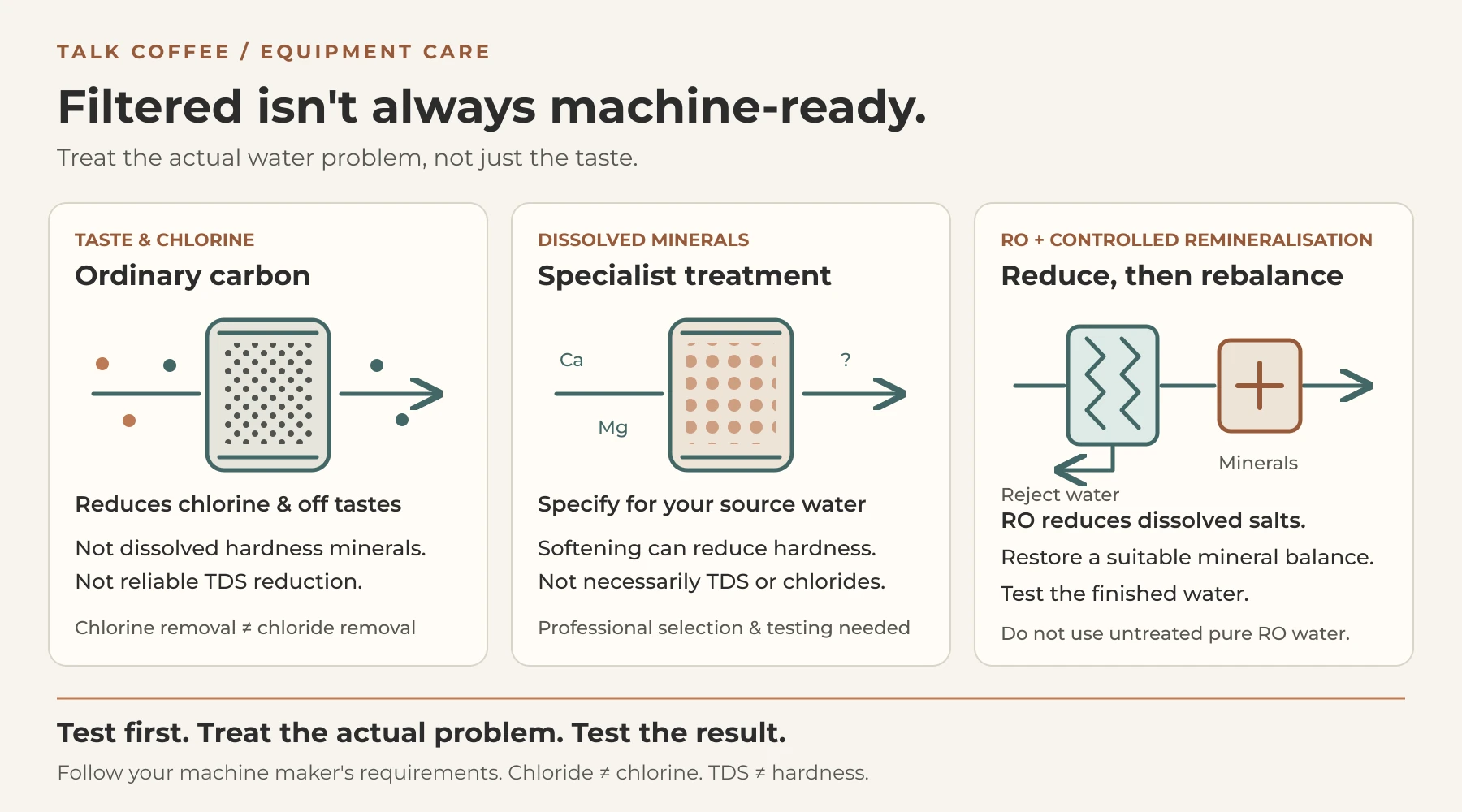
Carbon filtration, specialist mineral treatment and remineralised RO do different jobs. View full-size illustration.
A sediment or ordinary carbon filter does not remove dissolved hardness minerals or reliably reduce TDS. Carbon treatment can address chlorine and taste; a cartridge must be specifically rated for the contaminants concerned. Removing an unpleasant taste is not proof that the water will protect a boiler.
If your TH and/or TDS remain too high for the machine after ordinary filtration, do not keep using that water on the assumption that a bigger carbon filter, a fresh fridge cartridge or a different ordinary filter jug will solve it.
There is an important distinction here: specialist ion-exchange or demineralisation treatment can reduce hardness in appropriate circumstances. A softener, however, does not necessarily lower TDS or remove chlorides. It needs to be specified for the actual water, correctly sized, maintained and checked. La Marzocco advises caution with sodium- and hydrogen-based softeners.
For a home owner whose water cannot be brought within specification by ordinary filtration, our practical recommendation is to move to one of two verified water sources:
Reverse osmosis with controlled remineralisation. Have a professional specify the system and test its finished water. The aim is suitable, balanced water, not simply stripping everything out. Do not put untreated pure RO water into the machine.
Bottled drinking water that has been tested and meets the machine's specifications. Not every bottle is suitable. Some mineral and spring waters are far too mineral-rich; some purified waters have too little mineral content. Check the exact product and retest if its source or composition changes.
Do not add table salt or improvise a mineral recipe to correct a reading. Uncontrolled additions can create a different problem, especially with chlorides and stainless steel.
Brisbane, Adelaide, Perth and country areas: be vigilant
We particularly urge owners in Brisbane, Adelaide, Perth and many country areas to check hardness and mineral content before filling a new machine. These are places where harder or mineral-rich supplies can require more than an ordinary carbon filter.
This does not mean every suburb has the same water or that every supply falls into the same formal hardness category. Sources, blends and seasonal conditions vary. Country and bore-water supplies deserve particular attention. Water Corporation notes that regional WA customers are more likely to encounter hard water because many supplies rely on groundwater.
A water supply can meet Australian drinking-water requirements and still be outside an espresso machine's much narrower operating requirements. A postcode average or a neighbour's filter choice is no substitute for testing your own supply.
Stainless steel boilers need particular care
Stainless steel is not immune to poor water. It can still accumulate scale, and chlorides can cause localised pitting corrosion in hot stainless steel boilers. Damage may develop without an obvious warning in the cup.
Chloride and chlorine are different. Carbon treatment that reduces chlorine does not demonstrate that dissolved chlorides have been removed. La Marzocco specifically highlights chloride-related pitting corrosion. Do not assume that a stainless steel boiler, a low TDS reading or good-tasting water makes the risk disappear. Other boiler materials also need suitable water.
Have the water professionally tested
For hard, uncertain or changing supplies, arrange professional testing through a competent water-treatment specialist or a suitably accredited laboratory. Ask for TH, TDS or conductivity, alkalinity, pH, chloride, free chlorine and total chlorine, with further tests as the source requires.
Test a fresh cold, untreated source-water sample to establish what the treatment needs to do.
Also test the cold treated water that will actually go into the machine to confirm the treatment works.
Follow the laboratory's sampling instructions. Do not draw a diagnostic source-water sample from a group head or steam boiler.
Retest as cartridges age, after treatment changes, after moving, or when the water supplier changes the source. A filter has a capacity limit; the calendar alone does not tell you whether it is still effective.
Very low-mineral water is not the answer either. As well as being unsuitable for flavour and some materials, it may interfere with conductivity-based boiler level sensing. Correctly remineralised RO water is different from pure RO, distilled or demineralised water.
The short version
Test first. Treat the actual problem. Test the result. If TH or TDS remain too high, ordinary filtration is not an effective solution. Use professionally specified, remineralised RO water or tested bottled drinking water that meets your machine's requirements. Keep checking it, particularly in hard-water areas and with stainless steel boilers.
If you are unsure, talk to us before using the water. A proper test and suitable water supply are a better starting point than trying to repair scale or corrosion later.